617-821-1757

Looking For FHA Loans?
Apply today for the mortgage
that’s right for you.
Unlock Low Rates with Ease
Discover how Geovanne Colon simplifies the mortgage qualification process for you.
Apply today for the mortgage
that’s right for you.
Unlock Low Rates with Ease
Discover how Geovanne Colon simplifies the mortgage qualification process for you.
Low Rate.
Zero Hassles.
Get a free quote
Low Rate.
Zero Hassles.
Get a free quote
Feel Overwhelmed by Mortgage Choices? I Understand.

Feeling Lost in a Sea of Mortgage Options? Finding the right mortgage can be a daunting task. With an overwhelming array of rates, terms, and lenders, it's easy to feel lost and uncertain. Are you worried about high interest rates, hidden fees, or choosing a mortgage that doesn't fit your long-term goals?

Welcome to Your Gateway to Home Ownership
Embark on a seamless journey towards your dream home with Geovanne Colon, your trusted ally in mortgage solutions. With years of expertise and a commitment to securing the lowest rates, my mission is to transform the complex landscape of home financing into a simplified, transparent path leading straight to the keys of your new home.
Why Choose Us?
Ready to Start?
Your perfect home won't wait forever, and neither should you. Begin your journey today with a loan officer that puts you first. By choosing us, you're not just getting a loan – you're gaining a lifelong partner in all your mortgage endeavors.
Start your no-obligation consultation now and join the myriad of satisfied homeowners who have unlocked the doors to their future with ease and confidence. Dive into our world of simplified lending, and let's turn your homeownership dreams into reality.
Welcome Home!
Loan Programs We Help With
Seamless Solutions, Limitless Possibilities
Residential Mortgage Programs
1. FHA Loans
Federal Housing Administration (FHA) Loans
• Suitable for first-time homebuyers
• Low down payment options (as low as 3.5%)
• Requires mortgage insurance
• Lenient credit scores accepted
• 203K Renovation Loans Available
2. Conventional Loans
Conventional Mortgage Loans
• Preferred by borrowers with stronger credit
• Down payments as low as 3%
• Available in fixed or adjustable rates
• No government insurance premiums
• HomeStyle Renovation Loan Available
3. USDA Loans
US Department of Agriculture (USDA) Loans
• Ideal for eligible rural and suburban homebuyers
• Zero down payment
• Low insurance costs
• Income and geographic restrictions apply
4. VA Loans
Veterans Affairs (VA) Mortgage Loans
• Exclusively for veterans, active-duty service members, and eligible spouses
• No down payment required
• No mortgage insurance needed
• Competitive interest rates
A. ITIN - No Social Security Loans
• For borrowers with an Individual Tax Identification Number
• Lacks Social Security number
B. 1099 Loans
• Designed for independent contractors or self-employed individuals
• Based on the 1099 tax form income
C. VOE Only
• Verification of employment as the primary source of income validation
D. Asset Depletion
• Utilizes borrower's liquid assets for qualification purposes
E. Bank Statement Loans
• Income based on bank statements, suitable for self-employed borrowers
F. DSCR - Investor No Income Verification
• For real estate investors, using property cash flow as a qualification metric
Non-Qualified Mortgage (Non-QM) Loans
Loan Programs We Help With
Seamless Solutions, Limitless Possibilities
Residential Mortgage Programs
1. FHA Loans
Federal Housing Administration (FHA) Loans
• Suitable for first-time homebuyers
• Low down payment options (as low as 3.5%)
• Requires mortgage insurance
• Lenient credit scores accepted
2. Conventional Loans
Conventional Mortgage Loans
• Preferred by borrowers with stronger credit
• Down payments as low as 3%
• Available in fixed or adjustable rates
• No government insurance premiums
3. USDA Loans
US Department of Agriculture (USDA) Loans
• Ideal for eligible rural and suburban homebuyers
• Zero down payment
• Low insurance costs
• Income and geographic restrictions apply
4. VA Loans
Veterans Affairs (VA) Loans
• Exclusively for veterans, active-duty service members, and eligible spouses
• No down payment required
• No mortgage insurance needed
• Competitive interest rates
Non-Qualified Mortgage (Non-QM) Loans
A. ITIN - No Social Security Loans
• For borrowers with an Individual Tax Identification Number
• Lacks Social Security number
B. 1099 Loans
• Designed for independent contractors or self-employed individuals
• Based on the 1099 tax form income
C. VOE Only
• Verification of employment as the primary source of income validation
D. Asset Depletion
• Utilizes borrower's liquid assets for qualification purposes
E. Bank Statement Loans
• Income based on bank statements, suitable for self-employed borrowers
F. DSCR - Investor No Income Verification
• For real estate investors, using property cash flow as a qualification metric
More Loan Programs
Foreign National Loans
• Tailored for non-U.S. citizens looking to buy investment or vacation properties in the U.S.
• May require larger down payments and proof of foreign income.
Jumbo Loans
• Exceed the loan limits set by the FHFA for conventional mortgages.
• Requires non-traditional underwriting to accommodate the larger loan amount.
Real Estate Investor Loans
• Customized loans for experienced real estate investors.
• Can include options for multiple properties under a single loan (blanket loans).
Non-Warrantable Condo Loans
• For condos that do not meet specific requirements by Fannie Mae or Freddie Mac.
• Necessary for financing condos in buildings with more owner-occupied spaces or litigation issues.
Credit Event Loans
• Available to borrowers with significant derogatory credit events, such as bankruptcy or foreclosure.
• Typically requires a higher down payment or additional reserves.
Hard Money/Private Lending
•For immediate or short-term financing needs
• Higher-cost, short-term loans
• Asset-based lending criteria
• Terms typically around 12 months
Fix and Flips
• Loans crafted for renovating and flipping properties
Commercial Loans
•Tailored for businesses to purchase or refinance commercial property
• Offering solutions for office buildings, retail spaces, and industrial properties
• Custom terms to align with business strategies
New Construction
• Financing for ground-up construction projects
Small Business Administration (SBA) Loans
• Federally backed to help start or grow a business
• Lower down payments
• Longer repayment terms
• Focused on small businesses
Bridge Loans
• Short-term loans to bridge the gap during transitional periods
Down Payment Assistance Programs
• Provides prospective homebuyers with loans or grants that they can use toward the down payment for a house.
• Most down payment assistance programs are designed for first-time homebuyers and offered by various institutions, such as government, non-profits, or lenders.
More Loan Programs
Foreign National Loans
• Tailored for non-U.S. citizens looking to buy investment or vacation properties in the U.S.
• May require larger down payments and proof of foreign income.
Jumbo Loans
• Exceed the loan limits set by the FHFA for conventional mortgages.
• Requires non-traditional underwriting to accommodate the larger loan amount.
Real Estate Investor Loans
• Customized loans for experienced real estate investors.
• Can include options for multiple properties under a single loan (blanket loans).
Non-Warrantable Condo Loans
• For condos that do not meet specific requirements by Fannie Mae or Freddie Mac.
• Necessary for financing condos in buildings with more owner-occupied spaces or litigation issues.
Credit Event Loans
• Available to borrowers with significant derogatory credit events, such as bankruptcy or foreclosure.
• Typically requires a higher down payment or additional reserves.
Hard Money/Private Lending
•For immediate or short-term financing needs
• Higher-cost, short-term loans
• Asset-based lending criteria
• Terms typically around 12 months
Fix and Flips
• Loans crafted for renovating and flipping properties
Commercial Loans
•Tailored for businesses to purchase or refinance commercial property
• Offering solutions for office buildings, retail spaces, and industrial properties
• Custom terms to align with business strategies
New Construction
• Financing for ground-up construction projects
Small Business Administration (SBA) Loans
• Federally backed to help start or grow a business
• Lower down payments
• Longer repayment terms
• Focused on small businesses
Bridge Loans
• Short-term loans to bridge the gap during transitional periods
Down Payment Assistance Programs
• Provides prospective homebuyers with loans or grants that they can use toward the down payment for a house.
• Most down payment assistance programs are designed for first-time homebuyers and offered by various institutions, such as government, non-profits, or lenders.
Who We Help?
Seamless Solutions, Limitless Possibilities
First Time Home Buyers
We know how overwhelming the process of buying a home is, especially if it is the first time that you're doing it. We will work closely with you to explain the process, to protect you from making mistakes that could cost you later, and to ensure that your mortgage gets approved and you get the home that you are so excited to be buying!
Move Up and Second Home Buyers
Buying a new home when you currently own one has it's own unique set of concerns. We can answer all of your questions about how to qualify and purchase a home when you already own one whether you're buying a new primary residence or a second vacation home.
Refinancing Home Owners
If you already own your home but you are looking to refinance to either save money with a lower interest rate or possibly take some cash out for any reason, we can help you with that. We also can show you how to make sure you are structuring your new financing to get the best deal possible.
Investment Buyers
If you're buying real estate for investment purposes, we can help you secure low rate financing to maximize your ROI.
Seniors Seeking Reverse Mortgages
If you are 62 years or older and are looking for options to stay in your home without a mortgage payment or to access your home's equity while still living there, I can answer your questions about reverse mortgages so you can decide if they are right for you.
What My Clients Say
Ready to Find Your Perfect Mortgage?
Are You A First Time Home Buyer?
Download Our Free Home Buyer's Guide

Other Resources You'll Find Helpful

Buyer's Guide for Real Estate Agent
(English)

Buyer's Guide for Real Estate Agent
(Spanish)

Seller's Guide for Real Estate Agent
(English)

Seller's Guide for Real Estate Agent
(Spanish)
Calculate Your Mortgage Payment
Our Blogs
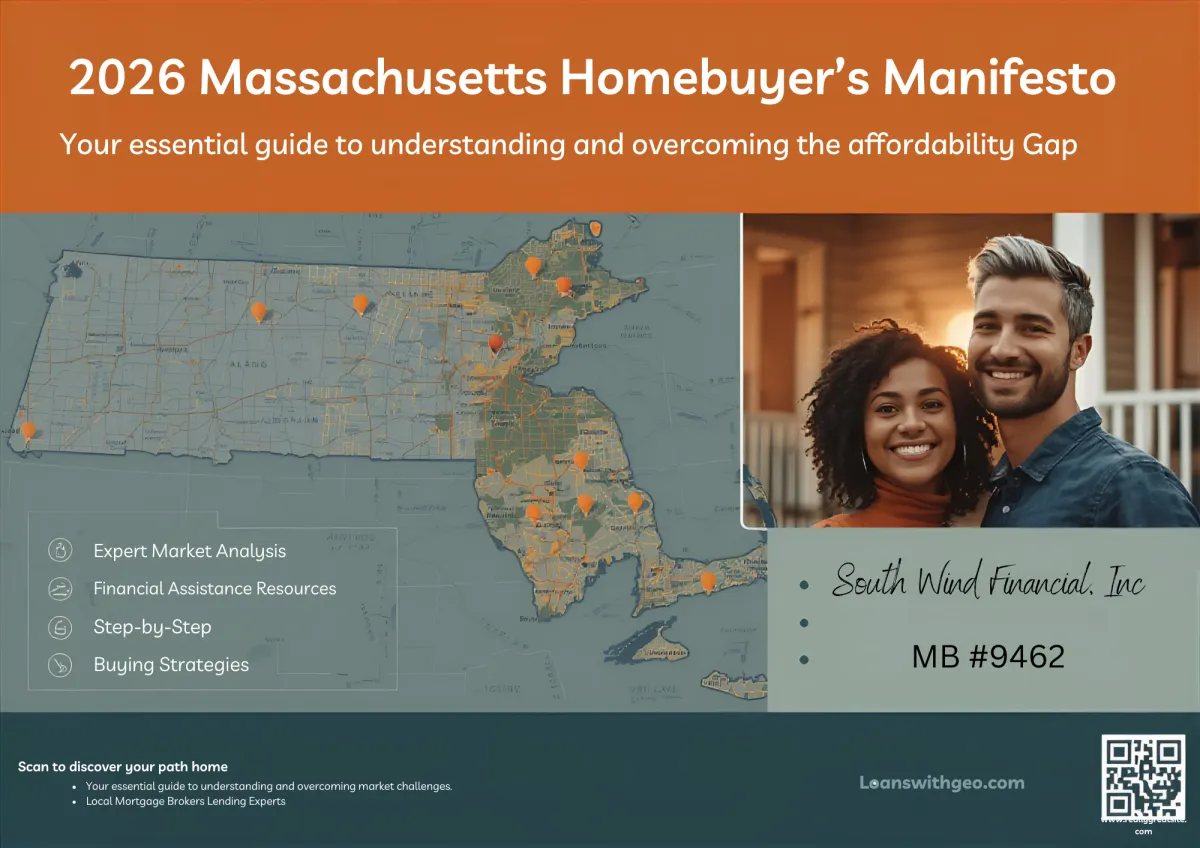
The 2026 Massachusetts Homebuyer’s Manifesto: Navigating the Affordability Gap
In the shadow of the Prudential Tower and across the historic cobblestones of Beacon Hill, a question echoes through the minds of every aspiring homeowner in the Commonwealth: "How much do I actually need to bring to the table?"
For decades, the "20% down" rule was the gold standard—a financial fortress that guarded against Private Mortgage Insurance (PMI) and signaled to sellers that you were a "serious" buyer. But as we move through January 2026, with the median down payment in Massachusetts hovering around $140,000, that 20% milestone feels less like a goal and more like a gatekeeper.
The "affordability gap" in 2026 has become a chasm. Yet, the irony of the current market is that while prices remain at historic highs, the entry requirements have never been more flexible. Whether you are staring at a $1.2 million condo in the Back Bay or a $480,000 triple-decker in Lowell, your strategy for a down payment will determine not just your monthly payment, but whether you can compete in a market where inventory remains the ultimate scarcity.
1. The Reality of the "Boston Tax"
Massachusetts real estate in 2026 is a study in "stabilized intensity." We aren't seeing the 15% year-over-year price jumps of the early 2020s, but the baseline has settled at a breathtaking altitude.
Median Home Price (Suffolk County): ~$875,000 – $980,000
The 20% Standard: $175,000 – $196,000
The 3.5% FHA Minimum: $30,625 – $34,300
The gap isn't just about the purchase price; it’s about liquidity. Most Massachusetts professionals have the income to support a mortgage—especially with rates finally stabilizing near 6.1%—but they lack the six-figure "war chest" required for a traditional down payment. This is where choosing the right loan vehicle becomes your most important financial decision.
In 2026, we see a "K-shaped" saving struggle. High earners in the biotech and tech sectors can save quickly, but the "middle-income squeeze" is tighter than ever. If you’re earning $120,000—a respectable salary—saving $200,000 for a down payment while paying $3,500 in rent for a two-bedroom in Somerville is a mathematical marathon that could take over a decade.
2. FHA vs. Conventional: The High-Cost Battleground
In a "High-Cost Area" like the Greater Boston metro, the rules of engagement change. The Federal Housing Finance Agency (FHFA) has pushed the 2026 Conforming Loan Limit for high-cost counties (Suffolk, Middlesex, Norfolk) to a staggering $1,249,125. This allows buyers to use conventional financing for homes that would have required "Jumbo" loans (and 20% down) just a few years ago.
The Conventional Route (3% to 5% Down)
Many buyers still assume Conventional loans require 20%. In reality, first-time buyers can often put down as little as 3%.
The Advantage: Once you reach 20% equity through a combination of payments and appreciation (which is projected at 3-5% statewide for 2026), your PMI drops off automatically. In a fast-moving market like Quincy or Somerville, you might hit that 20% mark in 3 to 5 years.
The Hurdle: Stricter credit requirements. To snag the best 2026 rates, you typically need a score above 720. Sellers also often view a 3% conventional offer as "stronger" than an FHA offer, assuming the buyer has better credit and fewer appraisal hurdles.
The FHA Route (3.5% Down)
The FHA loan remains the great equalizer for the "credit-challenged" or those with thinner savings.
The Advantage: You can qualify with a credit score as low as 580. Furthermore, FHA guidelines are often more lenient regarding debt-to-income (DTI) ratios, allowing for a DTI as high as 45-50% in some cases.
The "MIP" Reality: Unlike Conventional loans, FHA Mortgage Insurance Premium (MIP) usually stays for the life of the loan if you put down less than 10%. In a high-cost area, that extra $350–$600 a month can be a significant drag on your long-term wealth building. However, for many in 2026, it’s the only path to the closing table.
3. Geographic Arbitrage: Mapping the Opportunity
The "how much" depends entirely on the "where." To navigate the 2026 market, you must understand the pricing tiers across the Commonwealth. Let's look at the spectrum of Massachusetts markets.
Tier 1: The Luxury Core (Boston, Cambridge, Brookline, Newton)
In these areas, the entry price is almost exclusively for those with significant cash or high-income stability.
Beacon Hill: Median ~$1.1M. Down payment: ~$38,500 (FHA) or $220k (20%).
Newton: A suburban powerhouse with median prices near $1.4M. Here, you often face "cash is king" competition, making anything less than 10% down difficult to get accepted.
The Strategy: For these areas, focus on "micro-units" or older condos that need work.
Tier 2: The "Commuter Golden Circle" (Quincy, Waltham, Salem, Framingham)
These cities offer urban amenities and reliable transit but at a 20-30% discount from the core.
Quincy: The "New Brooklyn." Median $700k. FHA Down: $24,500.
Waltham: A tech hub in its own right. Median $750k. FHA Down: $26,250.
Salem: A year-round cultural hub. Median $620k. FHA Down: $21,700.
Framingham: Excellent for families. Median $650k. FHA Down: $22,750.
The Strategy: Use these as "starter" locations. The appreciation in these areas is often higher than the Boston core as people get priced out of the city.
Tier 3: The Value Frontier (Worcester, Lowell, Brockton, New Bedford)
This is where the "affordability gap" is bridged through volume and grit.
Worcester: Still the #1 growth prospect for 2026. Median $460k. 3% Conv Down: $13,800.
Lowell: Post-industrial charm with a growing arts scene. Median $500k. FHA Down: $17,500.
Brockton: One of the last bastions of the $400k single-family home. Median $430k. FHA Down: $15,050.
New Bedford: The "South Coast Rail" extension is finally fully operational, driving up demand. Median $410k. FHA Down: $14,350.
Tier 4: The Coastal/Rural Reach (Hingham, Scituate, Fitchburg)
Hingham/Scituate: For those prioritizing the ocean. Median $900k+. High barriers to entry.
Fitchburg: The "deep value" play. Median $375k. You can often buy here with less than $15,000 total cash to close if you use grants.
4. 2026 Down Payment Assistance: The New "Secret Weapons"
If the math still feels impossible, the Healey-Driscoll administration has introduced several lifelines in early 2026.
Expanded MassHousing DPA: In January 2026, Governor Healey announced an expansion of down payment assistance. Eligible middle-income buyers (earning up to $205,335 in some areas) can now access up to $30,000 in assistance. This can be structured as a 0% interest deferred loan—meaning you don't pay it back until you sell or refinance.
The $25,000 Middle-Income Grant: A new $25 million investment specifically targets 1,000 middle-income households, providing immediate relief for those who "make too much" for traditional low-income grants but not enough to save $100k for a down payment.
In House Lender DPA programs tailored for First Time Home Buyers.
5. Financial Engineering: How to Save in 2026
In a state with a 5.0% flat income tax and high cost of living, saving is a tactical sport.
The "Tax Refund Buffer": The average MA refund is roughly $3,000. Funneling this directly into a High-Yield Savings Account (HYSA) (which are still yielding around 4.2% in early 2026) is step one.
The 401(k) Loan Strategy: While risky, many Boston professionals use a loan from their 401(k) to cover the down payment. You’re essentially paying interest back to yourself.
The "Skin in the Game" Minimum: Most state programs require you to contribute at least 1.5% of the purchase price from your own funds. For a $500,000 home, that’s $7,500. Focus on hitting this "Magic Number" first.
6. Case Studies: Three Paths to Ownership
Scenario A: The "City Specialist" (Back Bay Condo - $900,000)
Buyer: Software Engineer, $160k salary.
Strategy: 5% Conventional Down ($45,000).
Outcome: High monthly payment ($5,800), but location eliminates the need for a car ($10,000/year savings).
Scenario B: The "Worcester House Hacker" (Three-Family - $650,000)
Buyer: Teacher and Nurse, $130k combined.
Strategy: 3.5% FHA Down ($22,750).
Outcome: Two rental units cover $3,000 of the mortgage. Net housing cost: $1,200/month.
Scenario C: The "South Coast Commuter" (New Bedford Single-Family - $415,000)
Buyer: First-Gen Homebuyer, $85k salary.
Strategy: MassHousing DPA ($30k) + $10k personal savings.
Outcome: Bought with almost $0 out of pocket after grants.
7. The "Hidden" Costs of Homeownership in MA
When calculating your "number," don't forget the "Boston Tax" on the back end. Beyond the down payment, you must budget 2% to 3% of the purchase price for closing costs.
In Massachusetts, this includes:
Attorney Fees: $1,500–$3,000 (MA is an attorney-close state).
Title Insurance: Roughly $4.00 per $1,000 of the purchase price. This is vital in a state with centuries of messy property records.
Prepaid Taxes/Insurance: Usually 3–6 months of escrow.
Home Inspection: $600–$1,000. In 2026, we strongly advise against "waiving inspection," a dangerous trend from 2021 that has led to a surge in structural litigation.
8. The 2026 Market Outlook: Why "Waiting" is a Gamble
The most dangerous thing a Massachusetts buyer can do in 2026 is wait for a "crash" that likely isn't coming. With the Fed signaling potential rate cuts toward the end of the year, a wave of "sidelined buyers" is expected to flood the market by Summer 2026.
If you buy now with 3.5% down, you are securing the home at today's price. If rates drop later, you can refinance. If you wait for rates to hit 5%, you may find that the $500,000 home in Lowell is now $560,000 due to increased competition. In Massachusetts, demand is fueled by a permanent housing deficit of over 200,000 units—math that guarantees price stability for the foreseeable future.
Bridging the Gap
The "affordability gap" is a psychological hurdle as much as a financial one. In 2026, the barrier to entry has shifted from "How much do I have?" to "How well do I know the programs?"
You don't need $200,000 to live in Boston. You need a strategy, a high-yield savings account, and a deep understanding of the geographic arbitrage available along the Commuter Rail. Whether it’s the high-rises of the Seaport or the triple-deckers of Worcester, your 2026 home is closer than the headlines suggest. Contact Geovanne Colon at South Wind Financial Today for a free consultation.

The 2026 Massachusetts Homebuyer’s Manifesto: Navigating the Affordability Gap
In the shadow of the Prudential Tower and across the historic cobblestones of Beacon Hill, a question echoes through the minds of every aspiring homeowner in the Commonwealth: "How much do I actually need to bring to the table?"
For decades, the "20% down" rule was the gold standard—a financial fortress that guarded against Private Mortgage Insurance (PMI) and signaled to sellers that you were a "serious" buyer. But as we move through January 2026, with the median down payment in Massachusetts hovering around $140,000, that 20% milestone feels less like a goal and more like a gatekeeper.
The "affordability gap" in 2026 has become a chasm. Yet, the irony of the current market is that while prices remain at historic highs, the entry requirements have never been more flexible. Whether you are staring at a $1.2 million condo in the Back Bay or a $480,000 triple-decker in Lowell, your strategy for a down payment will determine not just your monthly payment, but whether you can compete in a market where inventory remains the ultimate scarcity.
1. The Reality of the "Boston Tax"
Massachusetts real estate in 2026 is a study in "stabilized intensity." We aren't seeing the 15% year-over-year price jumps of the early 2020s, but the baseline has settled at a breathtaking altitude.
Median Home Price (Suffolk County): ~$875,000 – $980,000
The 20% Standard: $175,000 – $196,000
The 3.5% FHA Minimum: $30,625 – $34,300
The gap isn't just about the purchase price; it’s about liquidity. Most Massachusetts professionals have the income to support a mortgage—especially with rates finally stabilizing near 6.1%—but they lack the six-figure "war chest" required for a traditional down payment. This is where choosing the right loan vehicle becomes your most important financial decision.
In 2026, we see a "K-shaped" saving struggle. High earners in the biotech and tech sectors can save quickly, but the "middle-income squeeze" is tighter than ever. If you’re earning $120,000—a respectable salary—saving $200,000 for a down payment while paying $3,500 in rent for a two-bedroom in Somerville is a mathematical marathon that could take over a decade.
2. FHA vs. Conventional: The High-Cost Battleground
In a "High-Cost Area" like the Greater Boston metro, the rules of engagement change. The Federal Housing Finance Agency (FHFA) has pushed the 2026 Conforming Loan Limit for high-cost counties (Suffolk, Middlesex, Norfolk) to a staggering $1,249,125. This allows buyers to use conventional financing for homes that would have required "Jumbo" loans (and 20% down) just a few years ago.
The Conventional Route (3% to 5% Down)
Many buyers still assume Conventional loans require 20%. In reality, first-time buyers can often put down as little as 3%.
The Advantage: Once you reach 20% equity through a combination of payments and appreciation (which is projected at 3-5% statewide for 2026), your PMI drops off automatically. In a fast-moving market like Quincy or Somerville, you might hit that 20% mark in 3 to 5 years.
The Hurdle: Stricter credit requirements. To snag the best 2026 rates, you typically need a score above 720. Sellers also often view a 3% conventional offer as "stronger" than an FHA offer, assuming the buyer has better credit and fewer appraisal hurdles.
The FHA Route (3.5% Down)
The FHA loan remains the great equalizer for the "credit-challenged" or those with thinner savings.
The Advantage: You can qualify with a credit score as low as 580. Furthermore, FHA guidelines are often more lenient regarding debt-to-income (DTI) ratios, allowing for a DTI as high as 45-50% in some cases.
The "MIP" Reality: Unlike Conventional loans, FHA Mortgage Insurance Premium (MIP) usually stays for the life of the loan if you put down less than 10%. In a high-cost area, that extra $350–$600 a month can be a significant drag on your long-term wealth building. However, for many in 2026, it’s the only path to the closing table.
3. Geographic Arbitrage: Mapping the Opportunity
The "how much" depends entirely on the "where." To navigate the 2026 market, you must understand the pricing tiers across the Commonwealth. Let's look at the spectrum of Massachusetts markets.
Tier 1: The Luxury Core (Boston, Cambridge, Brookline, Newton)
In these areas, the entry price is almost exclusively for those with significant cash or high-income stability.
Beacon Hill: Median ~$1.1M. Down payment: ~$38,500 (FHA) or $220k (20%).
Newton: A suburban powerhouse with median prices near $1.4M. Here, you often face "cash is king" competition, making anything less than 10% down difficult to get accepted.
The Strategy: For these areas, focus on "micro-units" or older condos that need work.
Tier 2: The "Commuter Golden Circle" (Quincy, Waltham, Salem, Framingham)
These cities offer urban amenities and reliable transit but at a 20-30% discount from the core.
Quincy: The "New Brooklyn." Median $700k. FHA Down: $24,500.
Waltham: A tech hub in its own right. Median $750k. FHA Down: $26,250.
Salem: A year-round cultural hub. Median $620k. FHA Down: $21,700.
Framingham: Excellent for families. Median $650k. FHA Down: $22,750.
The Strategy: Use these as "starter" locations. The appreciation in these areas is often higher than the Boston core as people get priced out of the city.
Tier 3: The Value Frontier (Worcester, Lowell, Brockton, New Bedford)
This is where the "affordability gap" is bridged through volume and grit.
Worcester: Still the #1 growth prospect for 2026. Median $460k. 3% Conv Down: $13,800.
Lowell: Post-industrial charm with a growing arts scene. Median $500k. FHA Down: $17,500.
Brockton: One of the last bastions of the $400k single-family home. Median $430k. FHA Down: $15,050.
New Bedford: The "South Coast Rail" extension is finally fully operational, driving up demand. Median $410k. FHA Down: $14,350.
Tier 4: The Coastal/Rural Reach (Hingham, Scituate, Fitchburg)
Hingham/Scituate: For those prioritizing the ocean. Median $900k+. High barriers to entry.
Fitchburg: The "deep value" play. Median $375k. You can often buy here with less than $15,000 total cash to close if you use grants.
4. 2026 Down Payment Assistance: The New "Secret Weapons"
If the math still feels impossible, the Healey-Driscoll administration has introduced several lifelines in early 2026.
Expanded MassHousing DPA: In January 2026, Governor Healey announced an expansion of down payment assistance. Eligible middle-income buyers (earning up to $205,335 in some areas) can now access up to $30,000 in assistance. This can be structured as a 0% interest deferred loan—meaning you don't pay it back until you sell or refinance.
The $25,000 Middle-Income Grant: A new $25 million investment specifically targets 1,000 middle-income households, providing immediate relief for those who "make too much" for traditional low-income grants but not enough to save $100k for a down payment.
In House Lender DPA programs tailored for First Time Home Buyers.
5. Financial Engineering: How to Save in 2026
In a state with a 5.0% flat income tax and high cost of living, saving is a tactical sport.
The "Tax Refund Buffer": The average MA refund is roughly $3,000. Funneling this directly into a High-Yield Savings Account (HYSA) (which are still yielding around 4.2% in early 2026) is step one.
The 401(k) Loan Strategy: While risky, many Boston professionals use a loan from their 401(k) to cover the down payment. You’re essentially paying interest back to yourself.
The "Skin in the Game" Minimum: Most state programs require you to contribute at least 1.5% of the purchase price from your own funds. For a $500,000 home, that’s $7,500. Focus on hitting this "Magic Number" first.
6. Case Studies: Three Paths to Ownership
Scenario A: The "City Specialist" (Back Bay Condo - $900,000)
Buyer: Software Engineer, $160k salary.
Strategy: 5% Conventional Down ($45,000).
Outcome: High monthly payment ($5,800), but location eliminates the need for a car ($10,000/year savings).
Scenario B: The "Worcester House Hacker" (Three-Family - $650,000)
Buyer: Teacher and Nurse, $130k combined.
Strategy: 3.5% FHA Down ($22,750).
Outcome: Two rental units cover $3,000 of the mortgage. Net housing cost: $1,200/month.
Scenario C: The "South Coast Commuter" (New Bedford Single-Family - $415,000)
Buyer: First-Gen Homebuyer, $85k salary.
Strategy: MassHousing DPA ($30k) + $10k personal savings.
Outcome: Bought with almost $0 out of pocket after grants.
7. The "Hidden" Costs of Homeownership in MA
When calculating your "number," don't forget the "Boston Tax" on the back end. Beyond the down payment, you must budget 2% to 3% of the purchase price for closing costs.
In Massachusetts, this includes:
Attorney Fees: $1,500–$3,000 (MA is an attorney-close state).
Title Insurance: Roughly $4.00 per $1,000 of the purchase price. This is vital in a state with centuries of messy property records.
Prepaid Taxes/Insurance: Usually 3–6 months of escrow.
Home Inspection: $600–$1,000. In 2026, we strongly advise against "waiving inspection," a dangerous trend from 2021 that has led to a surge in structural litigation.
8. The 2026 Market Outlook: Why "Waiting" is a Gamble
The most dangerous thing a Massachusetts buyer can do in 2026 is wait for a "crash" that likely isn't coming. With the Fed signaling potential rate cuts toward the end of the year, a wave of "sidelined buyers" is expected to flood the market by Summer 2026.
If you buy now with 3.5% down, you are securing the home at today's price. If rates drop later, you can refinance. If you wait for rates to hit 5%, you may find that the $500,000 home in Lowell is now $560,000 due to increased competition. In Massachusetts, demand is fueled by a permanent housing deficit of over 200,000 units—math that guarantees price stability for the foreseeable future.
Bridging the Gap
The "affordability gap" is a psychological hurdle as much as a financial one. In 2026, the barrier to entry has shifted from "How much do I have?" to "How well do I know the programs?"
You don't need $200,000 to live in Boston. You need a strategy, a high-yield savings account, and a deep understanding of the geographic arbitrage available along the Commuter Rail. Whether it’s the high-rises of the Seaport or the triple-deckers of Worcester, your 2026 home is closer than the headlines suggest. Contact Geovanne Colon at South Wind Financial Today for a free consultation.
Subscribe to my newsletter
South Wind Financial, Inc.
Mortgage Broker Lic #MB9462
Branch NMLS #86116
1356 Atwood Ave. Johnston, RI 02919

Stay Connected:


Privacy Policy | Terms of Services
© Copyright All Rights Reserved