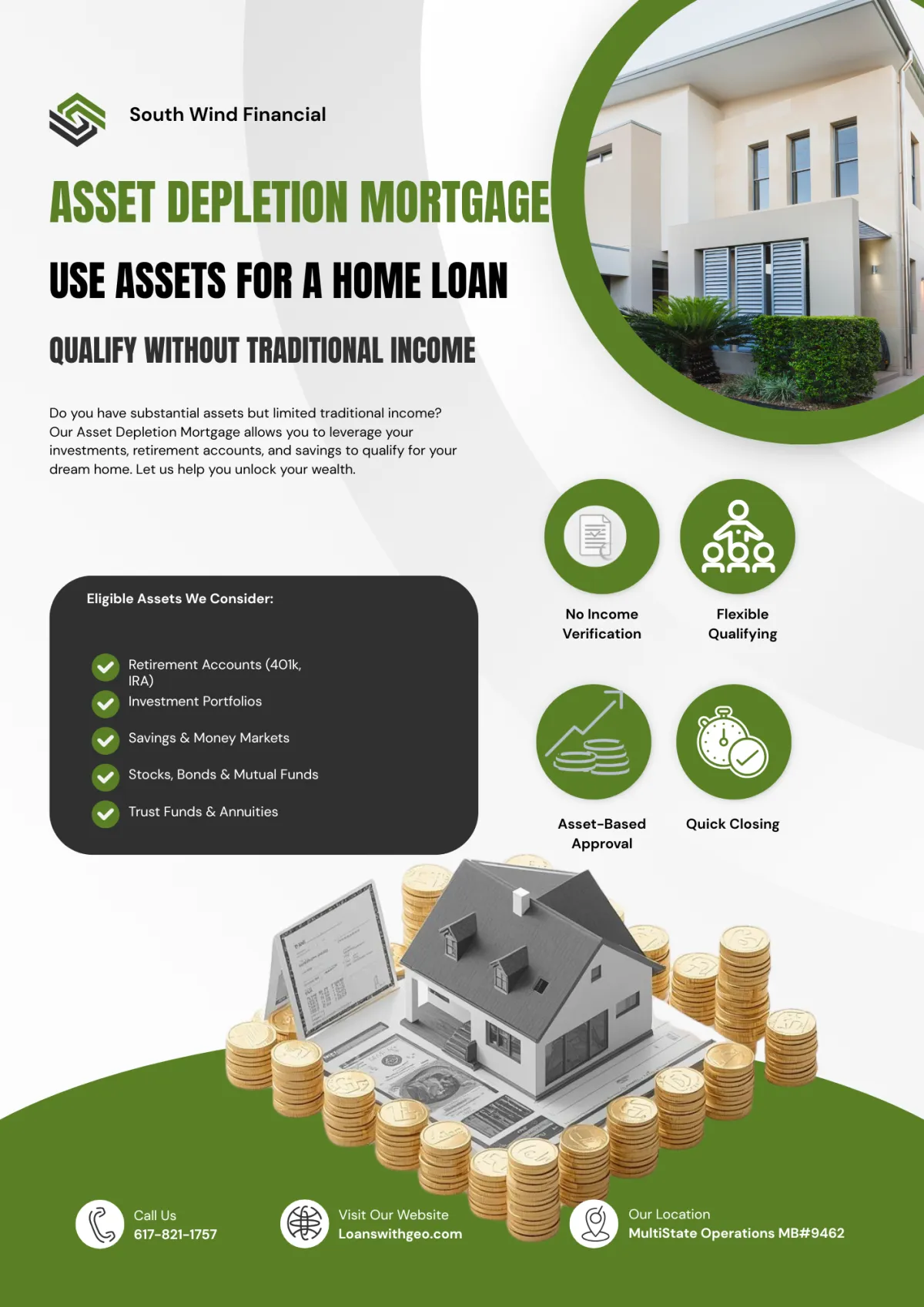
Asset Depletion Mortgage: Use Assets for a Home Loan
Asset Depletion Mortgage: Use Assets for a Home Loan
Dreaming of a new home or refinancing your existing mortgage, but your income doesn't quite fit the traditional mold? An asset depletion mortgage could be the answer. This unique home loan program allows you to qualify for a mortgage by using your assets to qualify, not just your income. Read on to discover how an asset depletion loan can open doors to homeownership, even if you're self-employed, retired, or have significant liquid assets but limited traditional income.
What is an Asset Depletion Mortgage?
Definition and Overview
An asset depletion mortgage, also known as an asset depletion loan or asset dissipation loan, is a type of mortgage loan that allows borrowers to qualify for a mortgage based on their assets rather than solely on their monthly income or employment income. This type of mortgage loan is particularly beneficial for individuals who have substantial assets but may not have consistent or easily documentable sources of income.
How It Turns Assets into Qualifying Income
The core concept of an asset depletion mortgage is turning your liquid assets into qualifying income that mortgage lenders can use to underwrite the loan and help borrowers qualify for a loan. Instead of relying on W-2s, tax returns, or pay stubs, the lender assesses your assets, such as savings, investments, and retirement accounts, and then uses an asset depletion calculation to determine a monthly income equivalent. This calculated figure is then used to help the borrower qualify for a mortgage and assess their ability to repay the loan.
Common Misconceptions
A common misconception is that an asset depletion mortgage is only for those with poor credit or no income. In reality, it’s a strategic option for those with significant assets who may find it difficult to qualify for a traditional mortgage due to the way their income is structured. Many borrowers with a solid credit score use an asset depletion program to secure mortgage lending that fits their unique financial situation, even when they may not have verifiable traditional employment income.
How Asset Depletion Loans Work
Calculation Methodology
The asset depletion calculation is the key to understanding how these loans work and how borrowers can qualify for a loan based on their assets. A mortgage lender will review your eligible assets, such as checking and savings accounts, stocks, bonds, money market accounts, and retirement accounts. They then divide the total asset value by a predetermined number of months to arrive at a monthly qualifying income. This calculated income is then used to determine if you qualify for an asset depletion mortgage.
Understanding the Time Frames
Here's how mortgage lenders might approach the asset depletion calculation, focusing particularly on the timeframe involved to help home buyers qualify for a loan. Common timeframes lenders consider are:
60 months
120 months
240 months is a common timeframe used in asset depletion calculations for mortgage borrowers.
360 months
A shorter timeframe will result in a higher monthly qualifying income, increasing your chances to qualify for an asset depletion. Conversely, a longer timeframe lowers the qualifying income but may still be sufficient depending on the desired loan amount and other factors.
Variability Among Lenders
It's crucial to understand that the specifics of asset depletion mortgages work differently depending on the mortgage lender. Each lender may have its own guidelines regarding eligible assets, acceptable timeframes for the asset depletion calculation, minimum credit score requirements, and other underwriting criteria. Some lenders offer asset depletion mortgages as non-QM loans, providing more flexibility, but potentially at higher mortgage rates.
Who Qualifies for Asset Depletion Loans?
Target Borrower Profiles
Asset depletion loans are particularly attractive to several borrower profiles. These include:
Retirees who have substantial retirement accounts but limited current income.
Self-employed individuals who may have high business expenses that reduce their reported income.
These borrowers often struggle to qualify for conventional loans but find asset-based options much more accessible.
Income Limitations and Asset Requirements
While asset depletion mortgages offer an alternative to traditional income verification, they do come with asset requirements. Generally, there isn't a strict income limitation, but rather a demonstration that your assets can adequately support the mortgage payment and help you repay the loan. The higher the loan amount, the larger the asset base needed to qualify for an asset depletion. Lenders will want to see that you have sufficient liquid assets to meet their requirements.
Specific Scenarios: Retirees and Self-Employed Borrowers
For retirees, an asset depletion mortgage allows them to leverage their retirement accounts to secure a home loan without needing to draw down large sums of money for a down payment. Self-employed borrowers can use this type of mortgage loan to overcome the challenges of documenting income through tax returns, especially when deductions and write-offs significantly reduce their taxable income. In both scenarios, the asset depletion program provides a pathway to homeownership that might otherwise be unavailable.
Eligible Assets for Asset Depletion Loans
Types of Acceptable Assets
When you want to use an asset depletion mortgage loan, it is crucial to know what assets a mortgage lender will consider. Typical eligible assets considered for asset depletion include checking and savings accounts, stocks, bonds, mutual funds, and retirement accounts like 401(k)s and IRAs. These liquid assets are easily converted to cash and can be used to qualify.
Restrictions on Asset Usage
There may be certain restrictions on asset usage for an asset depletion mortgage loan. For instance, some lenders might not consider assets that are not readily accessible or that have withdrawal penalties, such as certain retirement accounts. Additionally, assets already pledged as collateral for other loans might not be eligible for the asset depletion program.
Asset Seasoning and Distribution Considerations
Asset seasoning, or how long you have owned the assets, can be a factor. Some mortgage lenders may require assets to be held for a certain period before they can be used in the asset depletion calculation. Also, if you plan to take distributions from your retirement account to qualify for an asset depletion, the lender will consider the tax implications.
Pros and Cons of Asset Depletion Mortgages
Advantages of Using Asset Depletion Loans
An asset depletion mortgage offers numerous advantages, especially for those who don't fit the traditional borrower profile. One of the biggest benefits is the ability to qualify for a mortgage without needing W-2s or tax returns. This asset-based flexibility is ideal for self-employed individuals and retirees who might have challenges documenting stable monthly income, making it easier for them to qualify for an asset-based home loan.
Potential Drawbacks to Consider
While an asset depletion program is appealing, there are potential drawbacks. These home loans often come with higher mortgage rates than conventional loans, and they may require a higher down payment or a better credit score. Also, many asset depletion mortgages fall under the non-QM loan category, which might have additional regulations and requirements.
Comparative Analysis with Traditional Mortgages
When compared to traditional mortgages, an asset depletion mortgage stands out for its reliance on assets rather than income. Here's a quick comparison:
Feature of the asset-based home loan includes flexibility in qualifying for the mortgage. Asset Depletion Mortgage Conventional Mortgage Primary Qualification Factor Assets Income Income Documentation Less Stringent Extensive
Conventional loans typically require extensive income documentation, making it harder for self-employed or retired individuals to qualify. However, conventional loans often offer lower mortgage rates for those who can meet the income requirements.
Asset Depletion vs Other Loan Types
Comparison with Bank Statement Loans
Bank statement loans, like an asset depletion loan, are designed for self-employed borrowers. However, instead of using assets, bank statement loans use business or personal bank statements to verify income. Both an asset depletion mortgage and a bank statement mortgage provide alternative ways to qualify for a mortgage when traditional income verification is challenging.
Contrasting with 1099 Loans and DSCR Investor Loans
1099 loans use the borrower's 1099 forms to verify income, which can be simpler than full tax return documentation but still requires income verification. Debt Service Coverage Ratio (DSCR) investor loans, on the other hand, focus on the property's rental income to cover the mortgage payment, making them ideal for real estate investors. These home loans are often an asset-based alternative to a conventional mortgage.
Pros and Cons of Conventional Mortgages
Conventional loans typically offer the lowest mortgage rates and are a great option if you can qualify. However, mortgage borrowers require extensive documentation of income and a solid employment history to qualify for a conventional mortgage. Unlike an asset depletion mortgage, conventional lending is not flexible for borrowers with non-traditional income streams or significant assets but limited documented income.
Purchase vs Refinance Options
Rate-and-Term Refinance Explained
With a rate-and-term refinance using an asset depletion mortgage, you can replace your existing mortgage with a new one, potentially securing a lower interest rate or a more favorable loan term. This can be a great option if your home has appreciated in value, and you want to take advantage of better market conditions without needing to document traditional income.
Cash-Out Refinance Possibilities
A cash-out refinance involves borrowing more than your existing mortgage balance and receiving the difference in cash, which can help cover closing costs. With an asset depletion loan, this cash can be used for various purposes, such as home improvements, debt consolidation, or other investments. The mortgage lender will assess your borrower’s assets to ensure you qualify for the higher loan amount.
Factors Influencing Your Decision
Deciding between a purchase and a refinance with an asset depletion loan depends on your financial goals and current situation. If you're buying a new home and have substantial assets but limited income, an asset depletion loan can help you qualify for a mortgage. If you already own a home, a refinance can help you lower your interest rate or access cash for other needs.
Typical Requirements for Asset Depletion Mortgages
Credit Score and Down Payment Expectations
When you want to qualify for an asset depletion loan, understanding the credit score and down payment expectations is essential. A higher credit score often leads to better loan terms and interest rates, increasing your chances to get an asset depletion mortgage. Lenders use your credit history to assess risk, so aim for a solid credit score when applying for a home loan.
Debt-to-Income (DTI) Limits
Debt-to-income (DTI) limits are a crucial factor in the mortgage approval process, even with an asset depletion mortgage. While these loans focus on assets, lenders still consider your existing debts to ensure you can manage the mortgage payment. Lower DTI ratios generally make it easier to qualify for the loan amount you need under the asset depletion program.
Documentation Needs
Though asset depletion loans minimize traditional income documentation, certain documents are still required. Be prepared to provide statements for your liquid assets, such as retirement account statements, bank statements, and investment account records. Your lender will use these documents to verify that you have sufficient assets to qualify for an asset depletion loan and meet their lending criteria.
Practical Tips and Examples
Real-World Example of Asset Conversion
Consider a self-employed individual with $500,000 in liquid assets and limited documented income. If the lender uses a 240-month timeframe for the asset depletion calculation, this translates to $2,083 of qualifying income per month. This additional income can significantly improve their chances to qualify for a mortgage, making homeownership possible with an asset depletion program.
Common Pitfalls to Avoid
One common pitfall is underestimating the assets needed to qualify for an asset depletion mortgage. Borrowers should account for all mortgage-related expenses, including property taxes, insurance, and potential HOA fees. It’s crucial to work closely with loan officers to accurately assess your asset depletion mortgage needs and ensure you have sufficient liquid assets.
Why Choose Loanswithgeo.com for Asset Depletion Mortgages?
Expert Guidance and Nationwide Availability
Loanswithgeo.com provides expert guidance on asset depletion loans, helping you navigate the complexities of qualifying with assets instead of income. With nationwide availability, we can assist borrowers across the country in finding the best asset-based lending solutions. Our loan officers are well-versed in various asset depletion program options to help you qualify.
Flexible Non-QM Options
We specialize in flexible non-QM options, including asset depletion mortgages, to cater to borrowers with unique financial situations. Our approach allows self-employed individuals, retirees, and high-net-worth individuals to access home loans that conventional lenders might not offer. If you need an asset depletion mortgage, we provide mortgage lending solutions for those who don't fit traditional lending molds.
Personalized Service from a Trusted Mortgage Broker
At South Wind Financial Loanswithgeo.com, you'll receive personalized service from a trusted mortgage broker committed to understanding your specific needs. We'll work closely with you to assess your assets, guide you through the application process, and secure a mortgage loan that aligns with your financial goals. We offer expertise in asset depletion mortgages so you can make the right choices.
FAQs about Asset Depletion Mortgages
What if I don’t have traditional income?
If you don’t have traditional income, an asset depletion mortgage may be an ideal solution. This loan program allows you to qualify for a mortgage based on your assets rather than your monthly income. Lenders calculate a qualifying income by dividing your assets by a set number of months.
Can I use my retirement accounts as assets?
Yes, you can often use your retirement accounts as assets to qualify for an asset depletion loan. Mortgage lenders typically accept retirement accounts like 401(k)s and IRAs as eligible assets considered for asset depletion. It’s important to provide documentation of these accounts to your lender, so you can qualify for an asset depletion.
How long does the process take?
The timeline for an asset depletion mortgage can vary depending on the type of loan being considered. Generally, it may take slightly longer than a conventional loan due to the unique underwriting process of the asset depletion program. However, working with an experienced mortgage lender can help streamline the process and expedite your loan approval for an asset depletion.
